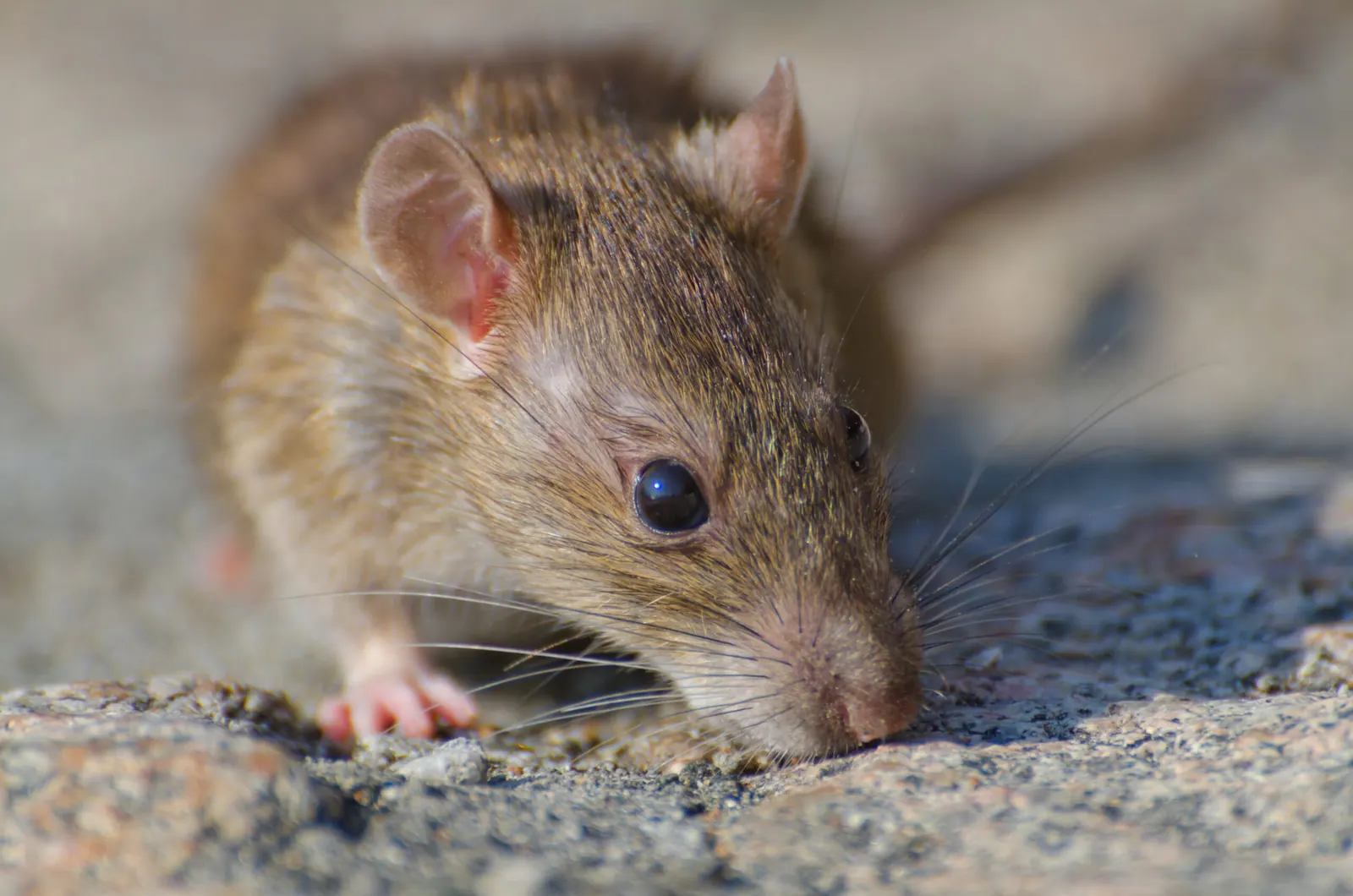
Find out how they get in
Every rat in a house used a way in, and that way is still open. They run the same route every night, so the evidence stacks up along one line: droppings at the base of a wall, dark grease smudges where their fur rubs on a beam or the edge of a hole, gnaw marks on wood, plastic and wiring. Follow that line back and it usually ends at one of these.
- A gap where a pipe, a drain or a cable passes through a wall or the floor.
- The space between the roof and the top of the wall, reached from a branch, a fence or a wire that touches the roof.
- A floor drain with a loose or missing cover.
- A door with a gap underneath wider than a finger.
- The opening for an aircon unit or an exhaust fan, with no mesh over it.
A rat can squeeze through a hole about the width of a thumb, and a mouse through far less, so small gaps count.
Take away what keeps them there
Rats stay where food, water and shelter are easy. Keep rice, pet food and anything that comes in a sack in hard containers with lids. Put rubbish in a bin with a tight lid. Clear the stacked boxes, old furniture and piles of wood from the garage, the bodega and the outside walls, because that is where they nest.
Trap the ones already inside
Snap traps and cage traps work best set on the route they already use, flush against the wall, where the droppings and grease marks are. Bait them with something they are already eating in the house. Rats are wary of anything new, so a trap can sit untouched for a few days before it starts working.
Poison is where most home efforts go wrong. A poisoned rat usually dies where it hides, often inside the ceiling or a wall, and the smell can last for weeks. Loose pellets also end up where children and pets can reach them. If bait is used at all, it belongs in a locked bait station that only a rat can get into.
If one has already died out of reach, dead rat smell covers finding it and cleaning up safely.
Which rat it is, the slim one in the ceiling or the heavy one from the drain, is in Tagalog with a real photograph in daga.
Close the way in
This is the part that makes the result last. Pack gaps around pipes with steel wool and seal over it, fit mesh over vents and drain grates, cut back branches that touch the roof, and put a sweep on any door with a gap under it. Do it after the ones inside are cleared, or you seal them in with you.
If it is mice (bubuwit)
Mice leave droppings of three to six millimetres, like dark grains of rice, against a rat’s two centimetres or so, and they leave dozens rather than a few. They nest closer to food: in drawers, in boxes of stored things, behind appliances.
The same three steps apply, scaled down. Use traps sized for mice, set close together along the walls where the droppings are, because mice usually stay much closer to their nest than rats do. Seal smaller gaps: a mouse gets through a hole about the width of a pencil, so steel wool and fine mesh matter more than they do for rats.
When to book an inspection
If you hear them in the ceiling every night, if droppings keep appearing after a week of trapping, or if wiring has been chewed, book an inspection. We find the entry points first, clear what is inside with trapping and baiting placed where children and pets cannot reach, then seal the way in.
We cover Pampanga, Bulacan, Bataan, Tarlac and Olongapo. Send a message through the contact form with your town and where you are hearing or seeing them, and we will get back to you to set a time.