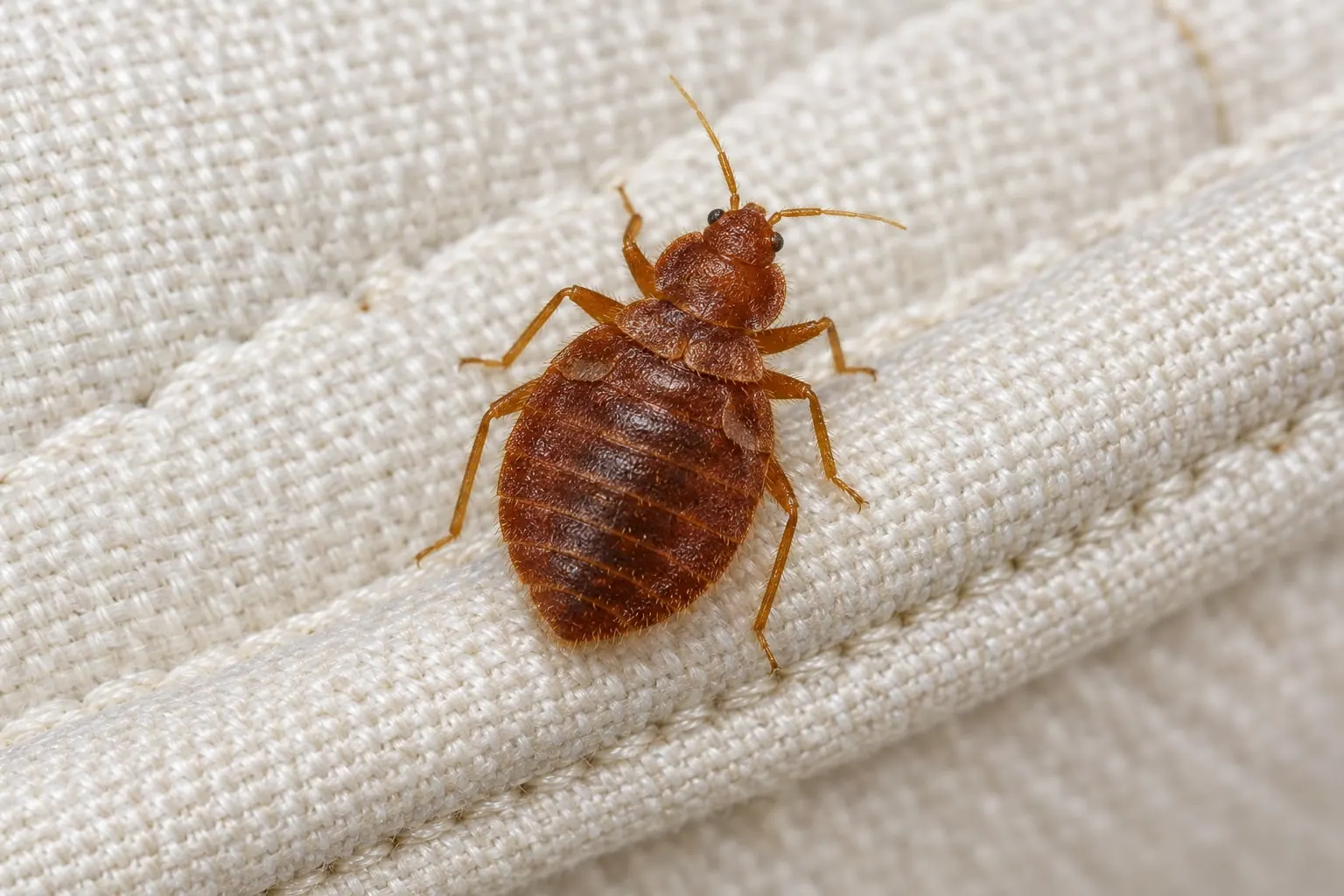
First, make sure it is bed bugs
Mosquito bites, dog ticks and a reaction to a new detergent all leave itchy red marks, so the bites alone cannot tell you what is biting. What settles it is the bed bug itself, or what it leaves behind:
- Small black or rust-coloured dots along the mattress seam, the edge of the sheet or the joints of the bed frame. These are bed bug droppings.
- Tiny blood smears on the pillowcase or sheet in the morning.
- Pale brown shed skins, the shape of a bed bug but empty.
- White eggs about the size of a pinhead, stuck in seams and in the corners of wooden frames.
- In a heavy infestation, a sweet, musty smell in the room.
Start with the mattress seams, the screw holes and joints of the bed, and the headboard. A torch and an old plastic card are enough to open a seam and look inside. If you are still unsure about the marks on your skin, what bed bug bites look like sets out how they compare with other bites.
Close-up detail on the eggs, and how to tell them from shed skins, is in bed bug eggs.
A real photograph of the adult, and the size of a bed bug at every stage, is in bed bugs.
What to do this week
None of this will clear a large infestation on its own, but it brings numbers down and stops them spreading while you work out the rest.
Bag the bedding, then heat it
Put sheets, pillowcases, curtains and any clothes near the bed into a plastic bag before you carry them out of the room, so nothing drops on the way. Wash in hot water if the fabric allows, then run it through a clothes dryer on high heat, which is what the US EPA recommends. The dryer heat does most of the work. If there is no dryer at home, a laundry shop will do.
Vacuum the seams and the floor around the bed
Go seam by seam along the mattress, then under the bed and along the skirting. Tie the vacuum contents in a plastic bag straight away and put it in the bin outside the house.
Take away places to hide
Pull the bed a little away from the wall, clear boxes and clothes from underneath it, and keep sheets off the floor. Fewer routes up the bed means fewer bites.
Encase the mattress
Zip-up covers made for bed bugs trap the ones inside so they cannot bite and eventually die, and new arrivals are easy to spot on the smooth fabric. Leave the cover closed for at least a year: UC IPM gives 20 to 400 days for how long a bed bug can go without feeding.
Put interceptors under the bed legs
These are small cups a bed bug can climb into but not out of. UC IPM reports that interceptors under the bed legs caught six times more bed bugs than people found by looking. Checked every week, they tell you whether numbers are going down.
What does not work as well as people hope
Drying the mattress in the sun. Heat helps, but the inside of a thick mattress rarely gets hot enough, and the bed frame, the sofa and the cracks in the wall are not in the sun.
Pouring boiling water on the bed frame. It kills the bed bugs it reaches. The ones deep in joints and screw holes survive, and wet wood can swell or grow mould.
Kerosene, petrol, thinner or rubbing alcohol. Do not. The US EPA warns they can harm the people in the house and catch fire from a spark or a cigarette.
Foggers and bug bombs. UC IPM says aerosol foggers are not effective against bed bugs and could harm your health, and the US EPA warns that misused foggers can cause a fire or an explosion.
Sleeping on the sofa. They follow, and now two rooms need treating.
Throwing out the mattress. The bed bugs in the frame and the wall are still there, and a mattress left on the street is often taken home by someone else.
Why bed bugs come back after spraying
UC IPM notes that several products are sold over the counter for bed bugs but few have been shown to work, and that resistance among bed bugs is increasingly common. Eggs hatch in about 10 to 15 days, so anything that missed them is followed by a new batch. Bed bugs also hide where a spray never lands: behind picture frames, inside furniture and electronics, in the joints of a wooden headboard.
In apartments, condos, dormitories and boarding houses they often come through the wall from the next unit. They also travel well in luggage, so a trip, a second-hand bed or a guest staying over can bring them back.
When to call a professional
If you have done everything above for two weeks and still find new bites, some are still somewhere. The same goes if:
- you are finding eggs or small young bed bugs, which means they are breeding in the house;
- more than one room shows signs;
- you live in an apartment, dorm or boarding house where they come from next door;
- there is a baby, an older person or someone with allergies at home who cannot wait several weeks.
If the swelling is severe or you develop a fever after bites, see a doctor first.
What we do when we come out
We start with an inspection of the mattress, the bed, the sofa, the cracks and the room next door, because that decides where treatment goes. We use heat and bed bug treatments chosen for the room and the people living in it, so that every stage is reached, eggs included. Then we follow up and tell you how to stop them coming back.
We cover Pampanga, Bulacan, Bataan, Tarlac and Olongapo. Leave a message on our contact form with your town and which room has the bites, and we will get back to you to set up the inspection. The same guide in Filipino is paano mawala ang surot sa higaan.
Sources
US EPA, Do-it-yourself Bed Bug Control, read 12 October 2026.
University of California IPM, Pest Notes: Bed Bugs, read 12 October 2026.
US Centers for Disease Control and Prevention, About Bed Bugs, read 12 October 2026.