Millipedes in the house: why they come in after rain
Millipedes do not bite and do not damage the house. They come in after heavy rain, looking for somewhere damp, and cannot live long in a dry room. The way to stop them is outside, where they breed.
If they come in by the dozen every time it rains, our general pest control and prevention visit treats the ground around the walls and points out what is keeping it wet.
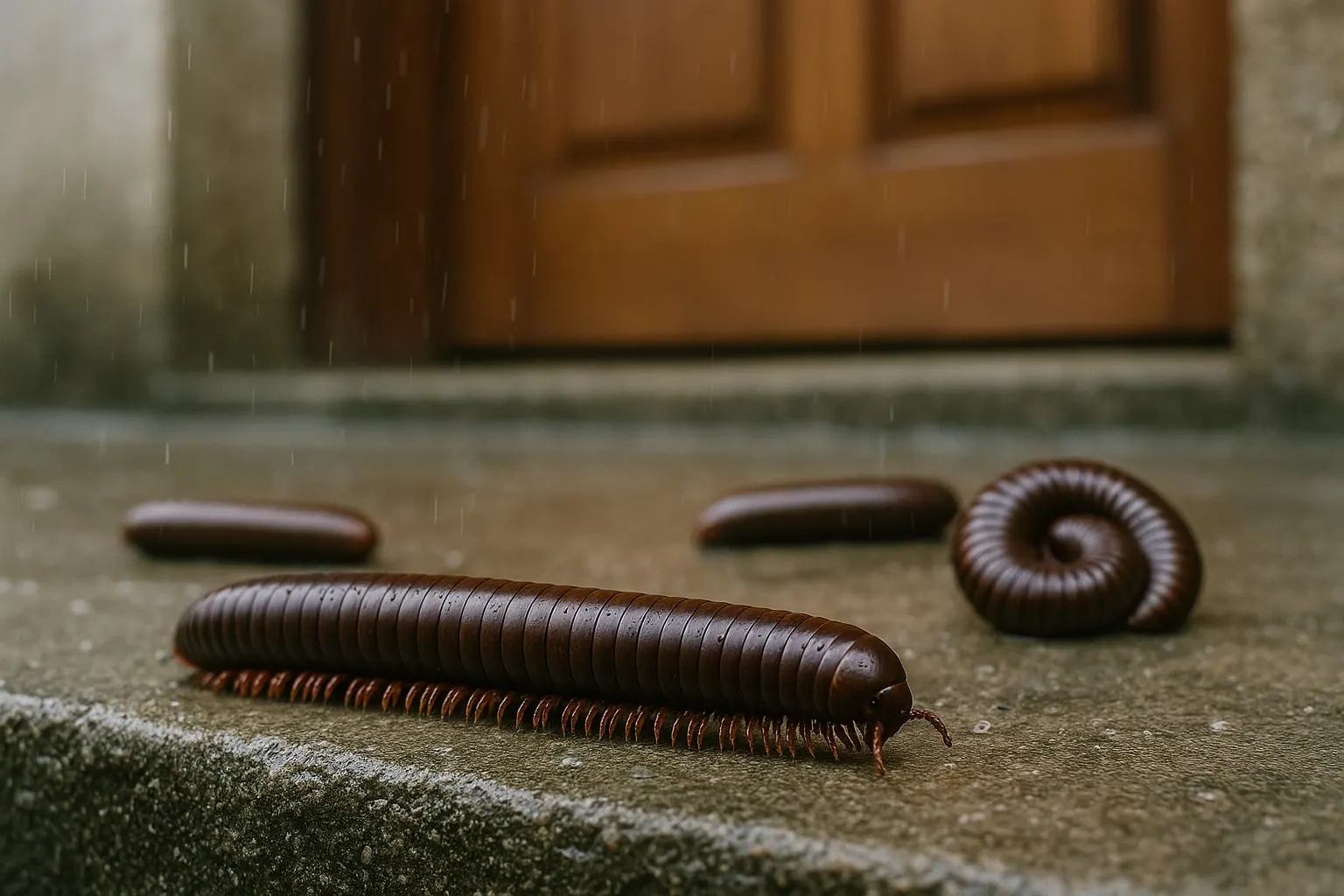
Why millipedes come into the house
Millipedes live outside in cool, damp places: under stones, pots and planks, in leaf litter, mulch and compost. They eat rotting plant matter. Every so often large numbers move at once, most often after heavy rain, and the ones that reach a wall follow it to the gap under a door. That is why a wet week in the rainy season can end with dozens on the doorstep and the floor inside.
Indoors, the dry air kills them. Penn State Extension says they do not live more than a few days inside most buildings, which is why the ones you find in the morning are often already dead and curled.
Are millipedes harmful?
They do not bite or sting, and they do not eat wood, food or fabric. The one thing to know is their defence: some millipedes release a fluid over their body when handled roughly. On skin it can burn or itch, raise blisters, and leave a brown stain that can take months to fade.
- On skin: wash with plenty of soap and water. Do not use alcohol.
- In the eye: rinse with plenty of water for at least 20 minutes, then see a doctor straight away.
Most symptoms are gone within a day. A blister that breaks can get infected, and a doctor should see it. Pick millipedes up with a dustpan or a glove, and keep children from playing with them.
Millipede or centipede?
The two get mixed up, and it matters, because only one of them bites.
| Millipede | Centipede (alupihan) | |
|---|---|---|
| Legs | Two pairs on each body segment, except the first three | One pair on each body segment |
| Body | Rounded, like a short length of wire | Flattened |
| When disturbed | Curls into a tight spiral | Runs fast |
| Eats | Rotting leaves and plant matter | Insects and spiders |
| Bites | No. Some give off a fluid that stains and stings | Yes, the big ones painfully |
If it was a centipede and it bit someone, see centipede bite.
How to get rid of millipedes
- Sweep or vacuum up the ones inside. They will not breed indoors, so there is nothing else to treat in the house.
- Clear what they live in near the walls: piles of leaves, grass cuttings, compost, stacked pots, planks and hollow blocks.
- Keep mulch thin, about 5 to 10 cm, so it dries out between rains, and pull it back from the foundation.
- Close the way in. Fit a door sweep or rubber strip to the gap under the door and fill cracks at the base of the wall.
- Fix the wet spots: a downspout that empties at the wall, a dripping outside tap, ground that slopes towards the house.
When the numbers are large, a band of treatment on the soil and wall around the house stops them before they reach the door. That is part of a general pest control visit. The same damp that brings millipedes also suits silverfish indoors and the termites in the ground, and the pest calendar for Central Luzon shows what each month of the rains brings. We cover Pampanga, Bulacan, Bataan, Tarlac and Olongapo.
Sources
- Penn State Extension, Millipedes, read 5 October 2026
- University of Florida IFAS Extension, Pillbugs, Sowbugs, Centipedes, Millipedes, and Earwigs (ENY-221), read 5 October 2026
- MedlinePlus (US National Library of Medicine), Millipede toxin, read 5 October 2026
Tell us what you have found
Send the pest, the town and roughly how long it has been going on. That is enough for us to say what the treatment would involve and what it depends on.